PracticalHomeEd
Startup Smart: A Homeschool Guide to Business Planning & Marketing
Startup Smart: A Homeschool Guide to Business Planning & Marketing
Couldn't load pickup availability
What if your teen's business idea actually had a plan behind it — a real one, built with the same tools working founders use?
Every teen with a business idea has the same instinct: skip straight to making it and worry about the rest later. That instinct isn't wrong — enthusiasm is real fuel — but a business built on excitement alone runs out of gas the first time a real customer asks a hard question, or the first batch costs more to make than it sells for.
Startup Smart is a homeschool guide for ages 13–18 that teaches the thinking that turns a good idea into a real, working plan. Not dense business-school theory — the same tools working founders actually use, scaled down to something a teenager can put into practice this month.
Every unit is drawn from real, named tools: Steve Blank's customer development model, the Business Model Canvas from Alexander Osterwalder and Yves Pigneur, Eric Ries's Lean Startup method, E. Jerome McCarthy's Four Ps of Marketing, and the real-venture pitching approach used by the Network for Teaching Entrepreneurship (NFTE) — a nonprofit that has taught business planning to hundreds of thousands of young people since 1987.
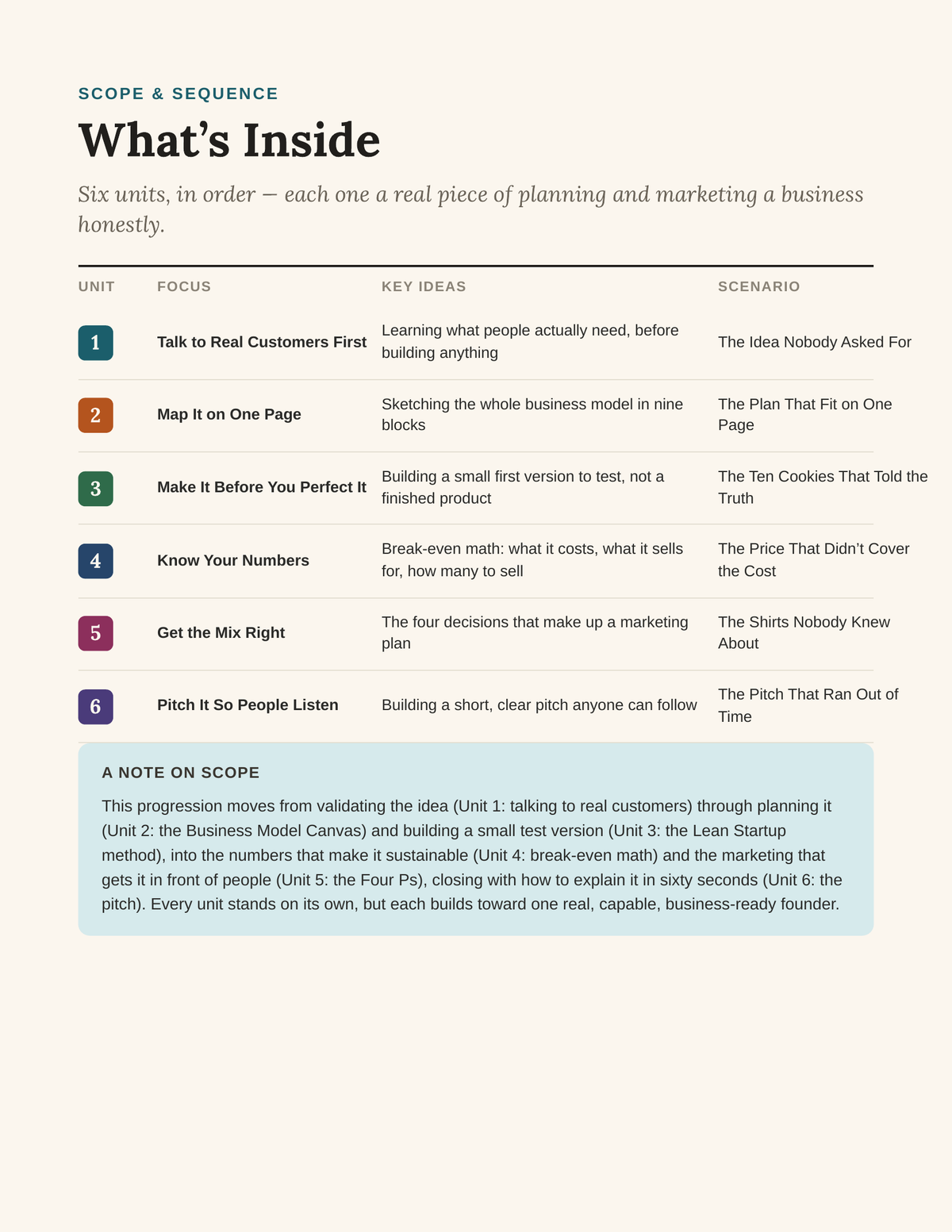
What's Inside
- Unit 1 – Talk to Real Customers First: Learning what people actually need, before building anything. (Scenario: The Idea Nobody Asked For)
- Unit 2 – Map It on One Page: Sketching the whole business model in nine blocks. (Scenario: The Plan That Fit on One Page)
- Unit 3 – Make It Before You Perfect It: Building a small first version to test, not a finished product. (Scenario: The Ten Cookies That Told the Truth)
- Unit 4 – Know Your Numbers: Break-even math: what it costs, what it sells for, how many to sell. (Scenario: The Price That Didn't Cover the Cost)
- Unit 5 – Get the Mix Right: The four decisions that make up a marketing plan. (Scenario: The Shirts Nobody Knew About)
- Unit 6 – Pitch It So People Listen: Building a short, clear pitch anyone can follow. (Scenario: The Pitch That Ran Out of Time)
How to Use This Guide
One unit per week gives a full six-week arc — or use any single unit on its own whenever it's needed. Each unit includes a strategy guide, a real-life scenario, four reflection prompts, and considered model responses so your teen can compare their thinking honestly.
Important note: This guide teaches real business-planning habits, not legal or financial advice. It doesn't cover the rules around a minor earning, banking, or paying taxes on business income, which vary by state and situation. Always check with a parent or trusted adult before spending money, signing anything, or taking payment from a stranger.
Instant digital download. Print-friendly PDF. No subscription required.
Share