PracticalHomeEd
The AI-Enhanced Homeschool Curriculum Planner: Smarter Prompts, Real Accommodations, Curriculum That Actually Fits
The AI-Enhanced Homeschool Curriculum Planner: Smarter Prompts, Real Accommodations, Curriculum That Actually Fits
Couldn't load pickup availability
Most “AI homeschool prompts” content gives you a list of things to copy and paste. Paste a generic prompt into a generic conversation, and you get a generic lesson — well-formatted, confident-sounding, and no better suited to your child than a worksheet pulled at random from a curriculum website.
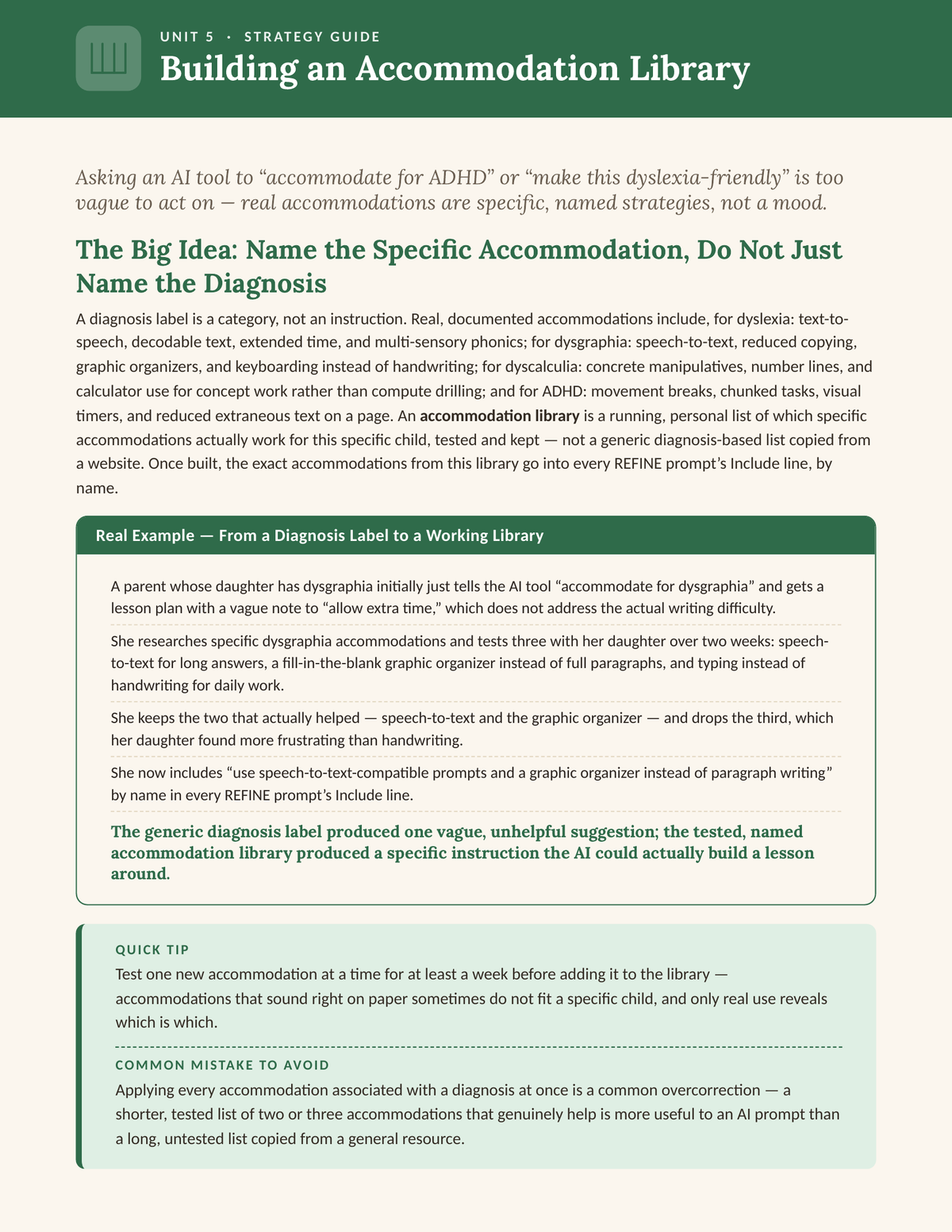
The AI-Enhanced Homeschool Curriculum Planner is a 23-page, 6-unit guide built around what most of that content leaves out: a real, named prompt-engineering framework, two advanced prompting techniques that make multi-step tasks genuinely easier for a learner who needs steps broken down, a concrete process for catching the confident wrong answers AI tools sometimes produce, and named, tested accommodations for dyslexia, dysgraphia, dyscalculia, and ADHD — not a vague instruction to “make it more engaging.”
What’s inside:
- Unit 1 – Naming What “Tailored” Actually Means: The learner profile, why generic prompts fail, and translating diagnosis notes into plain language the AI can actually act on
- Unit 2 – The REFINE Prompt Framework: Role, Expectation, Frame, Include, Nuance, Evaluate — a six-line prompt structure built for educators
- Unit 3 – Advanced Prompting: One-shot examples for a familiar format and chain-of-thought prompting for explicit step-by-step reasoning
- Unit 4 – The Six-Step Accuracy Check: Verifying citations, quotes, statistics, names, dates, logic, and tone before teaching from AI output
- Unit 5 – Building an Accommodation Library: Specific, tested, named accommodations for dyslexia, dysgraphia, dyscalculia, and ADHD — not a diagnosis label, a working list
- Unit 6 – The Weekly AI-Planning Rhythm: Combining the learner profile, REFINE, advanced prompting, and the accuracy check into one manageable weekly session
Every tool is drawn from real, named research and practice — Dr. Catlin Tucker’s REFINE method, fact-checking techniques adapted from academic research, and accommodation strategies from established learning-difference resources.
📄 23 pages · 6 units · Real Prompt Frameworks · Built for Neurodivergent Learners · Instant digital download
Share